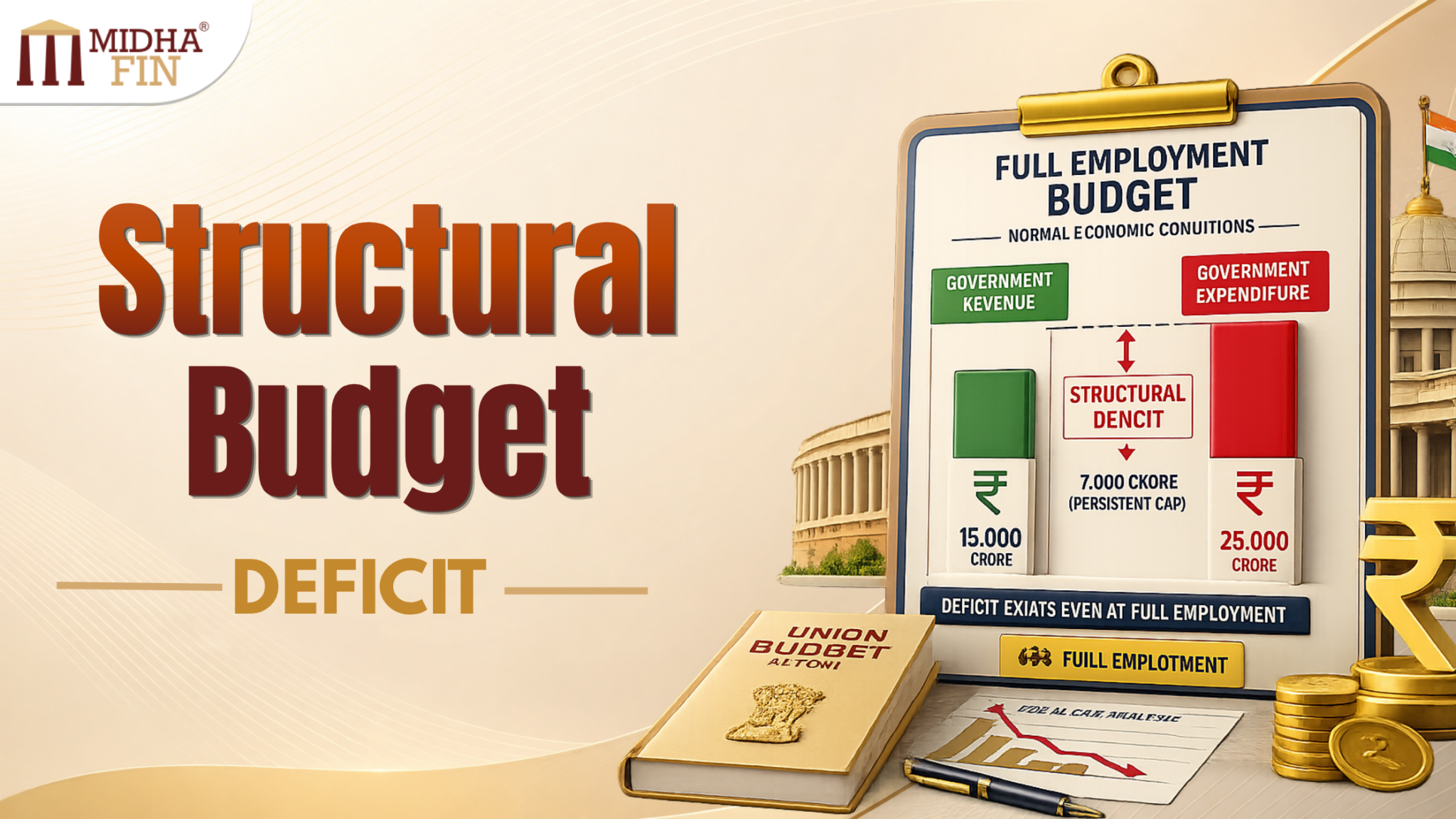
A government budget deficit is easy to understand at the first level.
The government earns some money through taxes and other sources. It spends money on salaries, defence, roads, subsidies, interest payments, welfare schemes, healthcare, education, and many other things.
When spending is higher than income, there is a deficit.
Simple.
But here is where the real question begins.
Why is the deficit happening?
Because the economy is temporarily weak?
Or because the government budget itself has a regular gap?
This difference is very important.
A structural budget deficit is the second case.
It means the government is short of money even when the economy is not in a crisis.
No recession.
No temporary shock.
No one-time emergency.
Still, the regular income of the government is not enough to cover its regular spending.
That is the problem.
The deficit is not coming only from a bad year. It is coming from the structure of the budget.
Think of it like a monthly household budget
Imagine a person earns ₹1,00,000 per month.
Their normal monthly expenses are ₹1,15,000.
Rent, food, school fees, fuel, electricity, medical expenses, EMI, insurance.
Nothing unusual.
No wedding expense.
No hospital emergency.
No sudden repair.
Just regular life.
Every month, there is a ₹15,000 gap.
That person can borrow for one month. Maybe two months. Maybe even for a year.
But the real issue is not that one month was bad.
The real issue is that the normal income is lower than the normal expense.
That is the easiest way to understand structural budget deficit.
The government version works in a similar way.
If the government has a regular gap between regular revenue and regular spending, it has a structural deficit.
Why this is different from a temporary deficit
Suppose the economy slows down.
Companies earn less profit.
Consumers spend less.
Jobs become weaker.
Tax collection falls.
At the same time, the government may spend more to support people and businesses.
So the deficit increases.
This is normal during a weak economy.
When the economy improves, tax revenue may recover and support spending may reduce. So this part of the deficit can come down naturally.
That is a cyclical deficit.
It is linked to the economic cycle.
But structural deficit does not go away so easily.
Even after the economy improves, the gap remains.
That is why it is more serious.
A cyclical deficit says:
The economy is weak right now.
A structural deficit says:
The budget itself is weak.
That is the real difference.
A small example
Suppose a government, in a normal year, earns ₹100 lakh crore.
Its normal spending is ₹112 lakh crore.
So even in a normal year, the gap is ₹12 lakh crore.
That ₹12 lakh crore is the structural deficit.
Now suppose the economy slows down.
Revenue falls to ₹94 lakh crore.
Spending rises to ₹116 lakh crore because the government gives more support.
Now the total deficit becomes:
₹116 lakh crore minus ₹94 lakh crore = ₹22 lakh crore
But the full ₹22 lakh crore is not structural.
The government already had a regular gap of ₹12 lakh crore.
The extra ₹10 lakh crore came because the economy slowed.
So we can think of it like this:
Structural deficit = ₹12 lakh crore
Cyclical deficit = ₹10 lakh crore
Actual deficit = ₹22 lakh crore
This is why economists do not look only at the headline deficit.
They try to understand how much of the deficit is temporary and how much is built into the system.
How does this problem start?
Structural deficit usually builds slowly.
It does not happen in one day.
The government may keep increasing long-term commitments.
More subsidies.
More pensions.
More salaries.
More interest payments.
More welfare spending.
More administrative expenses.
Some spending may be necessary. Some may be politically driven. Some may be inefficient. But once these commitments enter the budget, reducing them becomes difficult.
At the same time, revenue may not grow properly.
Maybe the tax base is narrow.
Maybe tax compliance is weak.
Maybe the informal economy is large.
Maybe there are too many exemptions.
Maybe economic growth is not turning into enough tax collection.
Slowly, the spending side becomes heavy and the revenue side does not catch up.
That is how a structural deficit becomes a regular problem.
Why growth alone may not fix it
A common mistake is thinking that economic growth will automatically solve the deficit.
Growth helps, but it may not be enough.
Suppose government revenue grows by 8 percent.
That sounds good.
But if government spending grows by 12 percent, the gap can still become larger.
So the real issue is not only growth.
The real issue is whether revenue growth is strong enough to support spending growth.
If spending keeps rising faster than income, the structural deficit remains.
This is why fiscal discipline matters even when the economy is doing well.
In fact, good times are the best time to fix a structural deficit.
Because during a crisis, fixing the budget becomes even harder.
Why structural deficit becomes dangerous
A government can borrow to cover the deficit.
That is normal.
But if the government borrows every year just to pay for regular spending, debt starts rising.
Once debt rises, interest payments also rise.
Then a bigger part of future revenue goes only into interest.
Let us say the government debt is ₹500 lakh crore.
Average interest rate is 7 percent.
Annual interest payment will be:
₹500 lakh crore × 7 percent = ₹35 lakh crore
Now debt rises to ₹600 lakh crore.
At the same interest rate:
₹600 lakh crore × 7 percent = ₹42 lakh crore
So the government now pays ₹7 lakh crore extra only as interest.
That extra amount does not build a new road.
It does not build a new hospital.
It does not improve education.
It only services past borrowing.
This is the slow pressure created by structural deficits.
They reduce future flexibility.
Why investors care about it
Bond investors care deeply about structural deficits.
They do not only ask:
What is the deficit this year?
They ask:
Will this deficit keep happening again and again?
A temporary deficit during a slowdown is easier to understand.
But a deficit that continues even in good times is a warning sign.
It means the government may have to keep borrowing.
If investors feel the borrowing path is becoming risky, they may demand higher yields.
Higher yields mean the government has to pay more interest.
Higher interest cost can make the deficit even worse.
So the problem can feed itself.
This is why structural deficit is important for government bond markets, sovereign credit ratings, currency stability, and investor confidence.
Not every deficit is equally bad
This point is important.
A government may borrow to build roads, ports, railways, power systems, schools, hospitals, or digital infrastructure.
That kind of spending can support future growth.
Future growth can improve future tax revenue.
So borrowing for productive assets can be more acceptable.
But if the government is borrowing mainly to pay recurring expenses, the concern is higher.
Salaries, subsidies, pensions, and interest payments come again and again.
They do not automatically create future income.
So analysts do not only look at the deficit number.
They ask what the deficit is funding.
That tells a better story.
A practical comparison
Country A has a deficit of 7 percent of GDP during a recession.
Country B has a deficit of 5 percent of GDP during strong growth.
At first, Country B looks better because 5 percent is lower than 7 percent.
But not always.
If Country A deficit is high mainly because of temporary weakness, it may reduce when the economy improves.
If Country B still has a 5 percent deficit during good times, then the problem may be deeper.
It means the gap is not because of bad conditions.
It is part of the normal budget.
That is why structural deficit gives a better picture than the headline deficit.
Why governments delay fixing it
Fixing a structural deficit is difficult.
The government may have to raise taxes.
People will resist.
It may have to reduce subsidies.
People will resist.
It may have to control pension spending.
People will resist.
It may have to cut wasteful expenses.
Affected groups will resist.
This is why the solution is not only economic.
It is political.
Everyone agrees in theory that the deficit should reduce.
But once the actual cuts or tax changes are discussed, resistance starts.
That is why structural deficits often continue for years.
The real cost
The real cost of a structural deficit is not only higher debt.
It is reduced choice.
When interest payments rise, the government has less space for useful spending.
When borrowing increases, future governments have less flexibility.
When investors become nervous, borrowing costs rise.
When fiscal pressure increases, taxes may rise later.
When the currency weakens, imports may become costlier.
So the cost does not appear in only one place.
It spreads across the economy slowly.
Why students should understand this
For finance students, structural budget deficit is important because it connects government finance with markets.
It affects bond yields.
It affects sovereign risk.
It affects currency pressure.
It affects inflation expectations.
It affects fiscal credibility.
It affects investor confidence.
It affects long-term debt sustainability.
This is why the concept is useful beyond exams.
It helps us understand why a government budget number can move markets.
Simple way to remember it
A cyclical deficit is caused by a weak economy.
A structural deficit is caused by a weak budget structure.
A cyclical deficit may reduce when the economy recovers.
A structural deficit remains even after the economy recovers.
That is the core idea.
Final thought
A structural budget deficit is not just a bad-year problem.
It is a regular-budget problem.
It means the government normal revenue is not enough for its normal spending.
That is why it is more worrying than a temporary deficit.
A country can manage a temporary deficit during a slowdown.
But a structural deficit needs deeper repair.
Better revenue collection.
Better spending discipline.
Better quality of expenditure.
Better long-term planning.
The simplest way to say it is this:
A structural budget deficit means the government budget has a built-in gap.
Unless that gap is fixed, borrowing, debt, and interest pressure can keep rising over time.
Loading comments...
Add your Thoughts: