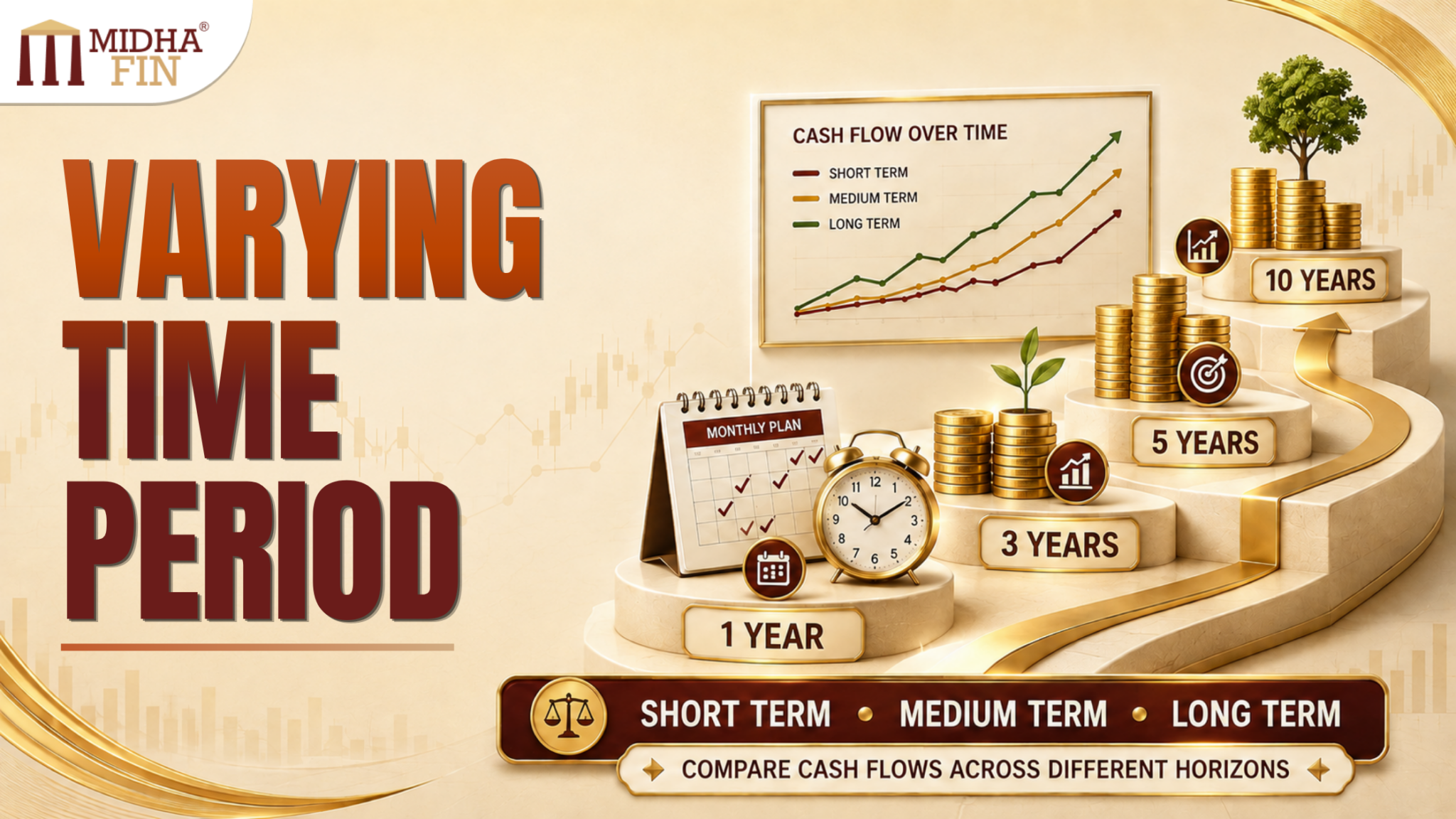
When students first learn time value of money, most questions look very neat. You invest today, receive money after one year, then maybe another amount after two years, and everything fits nicely into Year 1, Year 2, and Year 3. That is why many students start feeling that finance is just about putting numbers into a formula. But that comfort breaks the moment cash flows stop coming at equal intervals. And that is exactly where the idea of varying time period becomes important.
Varying time period simply means the money does not come or go at regular intervals. One cash flow may come after six months, another after fifteen months, and another after three years. In real life, this is actually more common than the neat textbook version. A business client may make part payment in three months, delay another payment, and clear the final amount much later. A startup investor may not exit after exactly five years. A bond may be purchased in between coupon dates. A project may start giving returns only after a construction phase. In all these cases, the amount matters, of course, but the timing matters just as much.
The easiest way to understand this is through a very normal question. If someone offers you ₹1,00,000 today or ₹1,00,000 after two years, which one would you choose? Most people will choose the money today. The reason is simple. Money in hand today gives you options. You can invest it, use it in a business, reduce a loan, or even just keep it aside for security. But if the same money comes after two years, all those opportunities are delayed. That delay has a cost. Finance tries to measure that cost, and that is why timing changes valuation.
Now think of two situations. In the first case, you receive ₹1,10,000 after one year. In the second case, you receive ₹1,10,000 after two years. At first glance, both look the same because the final amount is identical. But they are not the same at all. If your required return is 10 percent, then ₹1,10,000 received after one year is worth ₹1,00,000 today. But the same ₹1,10,000 received after two years is worth much less today, around ₹90,909. The amount is unchanged, yet the value is different. The difference comes only from time.
This is where many students make a very common mistake. They see a cash flow and automatically discount it for one year, two years, or three years because that is what they are used to doing. But what if the cash flow is after six months? Then it is not one year. It is half a year. What if it comes after eighteen months? Then it is one and a half years. The formula itself does not become difficult. The real challenge is being honest about the actual timing.
Suppose you are going to receive ₹1,00,000 after six months and the annual discount rate is 10 percent. The correct present value is not found by discounting for a full year. It should be discounted only for half a year. That gives a present value of roughly ₹95,346. But if someone carelessly discounts it for one full year, the answer becomes ₹90,909. That is clearly lower than it should be. The mistake did not happen because the formula was wrong. It happened because the timing was treated carelessly.
This becomes even more meaningful when there are multiple cash flows. Imagine a project that gives ₹2,00,000 after six months, ₹3,00,000 after one and a half years, and ₹5,00,000 after three years. At a 12 percent discount rate, each cash flow has to be discounted separately based on when it actually arrives. The first one is not handled like a one-year cash flow. The second one is not simply a two-year cash flow. Each amount has its own timing, so each one has its own present value. That is the only way to get the right total present value of the project.
The reason this topic matters so much is that real-world finance is full of uneven timing. In a classroom question, cash flows often behave nicely. In business, they rarely do. A company may receive an advance immediately, the next payment after inspection, and the last payment after delivery. A builder may receive instalments based on project milestones. A private equity investor may not know the exact exit date in advance. A lender may get an early repayment. A borrower may miss a scheduled payment and pay later. Once you start noticing real transactions, you realise that clean annual spacing is more of a teaching convenience than a real-life rule.
Varying time period also matters when money is being compounded, not just discounted. Let us say you invest ₹1,00,000 at 10 percent annual return. After two years, the future value becomes ₹1,21,000. But if the money stays invested for two and a half years, it grows to around ₹1,26,920. That extra half year may look small, but it still adds value. So whether you are bringing future cash flows back to today or carrying present money forward into the future, time has to be measured properly.
The same issue appears while comparing returns. If one investor earns 20 percent in one year and another earns 20 percent in three years, those two returns are not equal in any meaningful sense. The first investor did much better. The second investor took three years to earn the same total return. This is why finance students are taught to annualise returns. Without adjusting for time, return numbers can be misleading. A 12 percent gain over six months is not the same thing as a 12 percent gain over two years. The number may look the same, but the performance is not.
Loans give another very practical example. Suppose a company borrows ₹10 crore and repays ₹11 crore after nine months. Someone might say the cost is 10 percent because ₹1 crore extra was paid on ₹10 crore. But that 10 percent is for only nine months. Once we annualise it, the effective yearly cost becomes higher. So here again, the amount alone does not tell the full story. The time period changes the real meaning of the number.
This concept becomes especially important in NPV. Two projects may both promise the same total cash inflow, but the project that returns money earlier is usually more valuable. That is because earlier cash flows can be reinvested, used, or redirected sooner. A business owner understands this instinctively, even without finance formulas. If one customer pays in three months and another pays in fifteen months, both may eventually pay the same amount, but the earlier payment is clearly more useful. It supports working capital, reduces pressure, and creates flexibility.
In private equity, venture capital, real estate, and project finance, varying time period is not an exception. It is the norm. Cash flows come when milestones are achieved, deals close, assets are sold, or exits happen. That is why tools like XIRR become useful. A normal IRR assumes equal gaps between cash flows. XIRR allows actual calendar dates. This is a small technical difference, but it matters a lot when timing is irregular.
Even bond markets remind us that dates matter. If a bond is bought between coupon dates, the next coupon is not a full six months away. There will be accrued interest, settlement dates, and day-count conventions to consider. So even something that looks mechanical on the surface is deeply tied to timing.
The deeper lesson here is simple. In finance, money is never just about amount. It is about amount plus time. The moment the timing becomes uneven, the calculation also has to become more careful. Students often lose marks not because they do not know the formula, but because they do not pause to ask one basic question: when exactly is the cash flow happening?
That is why varying time period is such an important concept. It teaches us to stop forcing every cash flow into neat annual boxes. If a cash flow comes after six months, treat it as six months. If it comes after two and a half years, treat it as two and a half years. Finance rewards precision, and timing is one of the biggest places where precision matters.
The simplest way to remember it is this: the same money received at different times does not have the same value. Once you understand that properly, varying time period stops feeling like a confusing topic and starts feeling like common sense written in the language of finance.
Loading comments...
Add your Thoughts: