Risk shifting is one of those finance concepts that sounds technical, but the basic idea is very human.
When a person has little to lose and someone else bears most of the downside, that person may start taking bigger risks.
This happens in companies too.
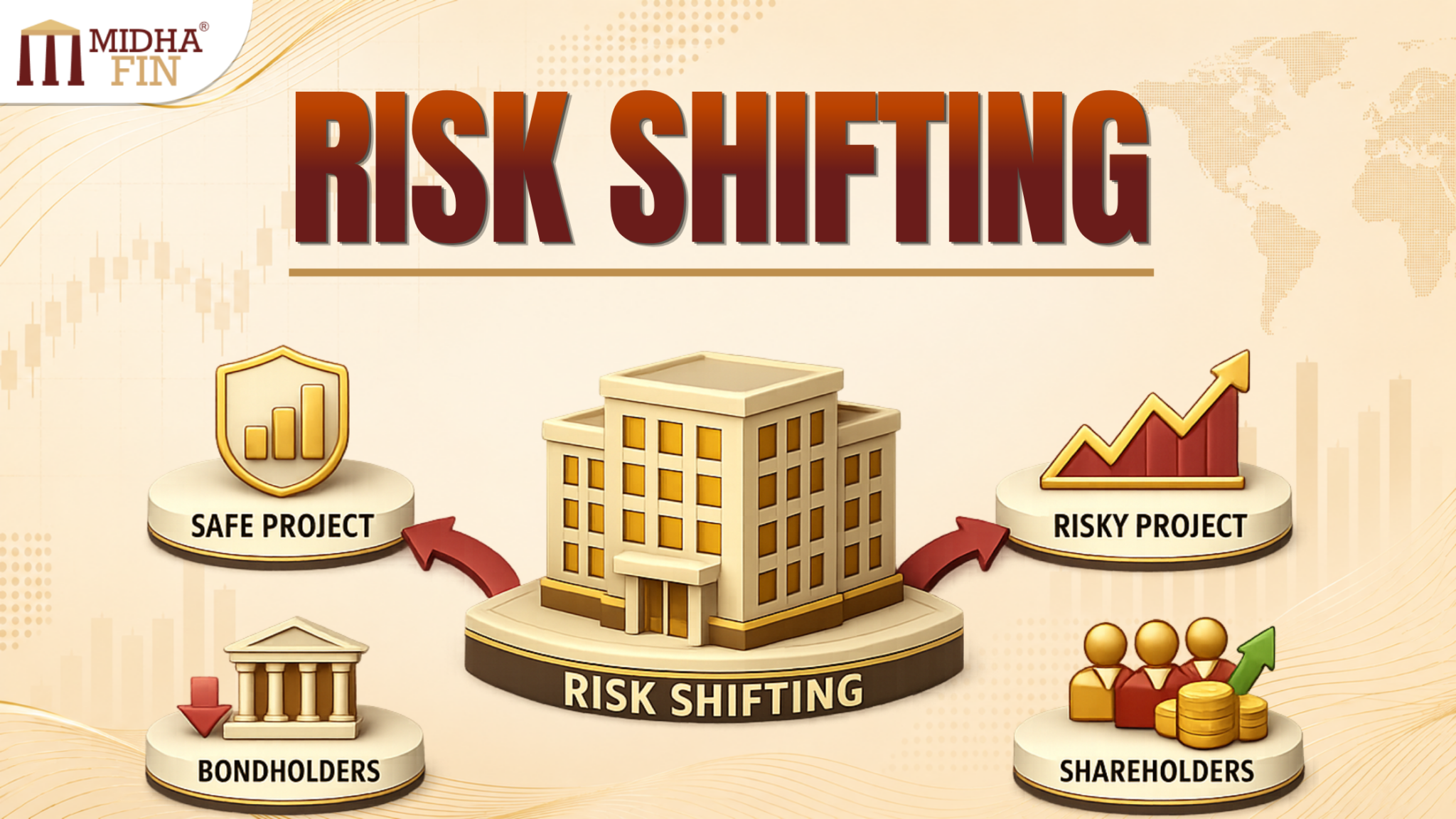
Risk shifting usually appears when a company has debt. The shareholders own the upside of the business, but debt holders have a fixed claim. If the company does well, shareholders enjoy most of the extra gain. If the company fails, debt holders may suffer because the company may not have enough assets to repay them fully.
This creates a conflict.
Shareholders may prefer the company to take higher-risk projects, especially when the company is already financially stressed. Debt holders may not like that because they do not get extra upside, but they can lose money if the risky project fails.
That is the core idea of risk shifting.
A company shifts risk from shareholders to debt holders.
Let us understand it slowly.
Imagine a company has borrowed heavily. Its business is weak. Its assets are worth ₹100 crore, but it owes ₹120 crore to lenders. Technically, shareholders are already in a difficult position because the debt is more than the value of the company assets. If nothing changes, shareholders may get nothing.
Now management has two possible projects.
The first project is safe. It may increase the company value from ₹100 crore to ₹110 crore.
The second project is risky. There is a chance it may increase the company value to ₹160 crore, but there is also a chance it may reduce the value to ₹70 crore.
From the debt holders point of view, the safe project is better. It protects value and increases the chance of recovery.
But shareholders may prefer the risky project.
Why?
Because in the safe project, company value becomes ₹110 crore, but debt is ₹120 crore. Shareholders still get nothing because lenders are still not fully paid.
In the risky project, if it succeeds and company value becomes ₹160 crore, debt holders receive ₹120 crore and shareholders may get ₹40 crore.
If the risky project fails and value falls to ₹70 crore, shareholders were already almost wiped out anyway. The additional pain falls mainly on debt holders because they recover even less.
So shareholders may think, why not take the risky bet?
If it works, they get something.
If it fails, lenders bear most of the damage.
This is risk shifting.
The decision may look attractive to shareholders, but it can destroy value for debt holders.
This is why risk shifting is also called an agency problem between shareholders and creditors.
The problem becomes stronger when a company is close to financial distress. When the company is healthy, shareholders still have a lot of value to protect. They may not want to gamble recklessly. But when the company is already in trouble, shareholders may behave like someone holding a lottery ticket. A risky project gives them a chance of recovery, even if it worsens the position of lenders.
This is not only a theoretical issue. It appears in real business decisions.
A struggling company may take on a high-risk expansion.
A heavily indebted company may invest in speculative projects.
A bank with weak capital may take risky lending decisions.
A firm near default may sell safe assets and invest in volatile assets.
The pattern is the same.
The party with limited downside starts taking more risk because someone else bears part of the loss.
Let us take a simple number example.
A company owes ₹500 crore to lenders. The current value of the company assets is ₹450 crore. If the company is liquidated today, lenders may recover ₹450 crore and shareholders get nothing.
Now the company has ₹50 crore cash left.
It can use this cash in two ways.
Option A is a safe project that will return ₹55 crore.
Option B is a risky project. There is a 50 percent chance it becomes ₹150 crore and a 50 percent chance it becomes zero.
From a total value point of view, Option A gives ₹55 crore. Option B expected value is:
50 percent × ₹150 crore + 50 percent × ₹0 = ₹75 crore
At first, Option B actually has higher expected value in this example. So it may not look like a bad decision.
But now change the numbers slightly.
Suppose Option B has a 20 percent chance of becoming ₹200 crore and an 80 percent chance of becoming zero.
Expected value is:
20 percent × ₹200 crore + 80 percent × ₹0 = ₹40 crore
Now Option B has lower expected value than the safe project. It destroys value overall.
But shareholders may still prefer it.
Why?
Because if the safe project works, company value rises from ₹450 crore to ₹455 crore or ₹505 crore depending on how we treat the cash and project value, but debt holders still capture most of the benefit. Shareholders may still get little or nothing.
If the risky project succeeds, company value may jump enough for shareholders to recover something after debt is paid.
If it fails, shareholders lose little additional value because their equity was already deeply out of the money.
So shareholders may prefer the lower expected value risky project because their payoff is asymmetric.
That asymmetry is the heart of risk shifting.
Debt holders hate this situation because they agreed to lend based on a certain risk profile. If the company later increases risk, the value of debt falls. The promised repayment does not increase, but the probability of default increases. That is bad for lenders.
This is why loan agreements and bond indentures often include covenants.
Covenants are restrictions placed on the borrower to protect lenders.
For example, lenders may restrict the company from taking additional debt beyond a limit. They may restrict asset sales. They may require the company to maintain certain financial ratios. They may restrict dividend payments. They may prevent the company from making very risky investments without lender approval.
The purpose is simple.
Debt holders know that once they lend money, shareholders may have an incentive to change behaviour. Covenants reduce that freedom.
Risk shifting can also happen in banks and financial institutions.
If a bank has very little capital, shareholders may want the bank to take bigger lending risks. If the risky loans succeed, shareholders benefit. If they fail, depositors, creditors, or even the financial system may suffer. This is why bank regulation focuses so much on capital requirements. Capital forces shareholders to have more skin in the game. When shareholders have more to lose, they are less likely to take reckless risks.
This idea also connects with moral hazard.
Moral hazard happens when one party takes more risk because another party bears some of the consequences. Risk shifting is a specific form of this problem in corporate finance, especially between shareholders and debt holders.
The concept is also linked to limited liability.
Shareholders have limited liability, which means they can lose only the amount they invested in the company. They are not personally responsible for all company debt. Limited liability is useful because it encourages investment and entrepreneurship. But in distressed companies, it can also encourage risk shifting. If shareholders can lose only their equity, they may prefer very risky projects when the equity value is already close to zero.
For analysts, risk shifting is important because it changes how we read corporate behaviour.
Suppose a highly leveraged company suddenly announces an aggressive expansion into a risky business line. A casual reader may think the company is being bold. But an analyst should ask a deeper question.
Is this a genuine value-creating investment?
Or is management taking a risky gamble because shareholders have little left to lose?
That question matters.
A project can be attractive for shareholders but harmful for the total firm value. This is why analysts should not look only at the equity story. They should also examine debt levels, maturity pressure, covenant flexibility, liquidity position, and asset quality.
Risk shifting can also affect bond valuation.
When a company increases its business risk after issuing debt, the market value of existing debt can fall. Bondholders were promised fixed payments, but now those payments have become riskier. If bond investors expect more risk shifting, they may demand higher yields, stronger covenants, or better collateral.
This is also why credit rating agencies pay attention to financial policy. A company that takes aggressive financial decisions, increases leverage, or moves into riskier operations may face rating pressure. The issue is not only current debt. It is also future behaviour.
There is another angle students should understand.
Risk shifting is different from normal business risk-taking.
Every company has to take some risk. Expanding into a new market, launching a product, investing in technology, or entering a new geography can all involve risk. That does not automatically mean risk shifting.
Risk shifting specifically refers to situations where the risk is taken in a way that benefits shareholders disproportionately while pushing downside risk toward debt holders or other claimants.
So the context matters.
A healthy company taking a well-analysed risky project may be normal business strategy.
A distressed, highly leveraged company taking a gamble with lenders money may be risk shifting.
This distinction is very important.
Let us bring it back to a simple human example.
Imagine a person owes ₹10 lakh and has only ₹1 lakh left. They can either use that ₹1 lakh to repay part of the loan or put it into a very risky bet. If the bet succeeds, they may recover enough to pay the loan and keep something. If the bet fails, they were already unable to repay anyway. From their personal point of view, the risky bet may feel tempting. But from the lenders point of view, it is dangerous because the remaining recovery value is being put at risk.
That is exactly how risk shifting works in corporate finance.
The party with the upside takes the gamble.
The party with the fixed claim bears much of the downside.
For CFA and finance students, the key lesson is that capital structure affects incentives. Debt is not just a source of funding. It changes behaviour. When debt is high, shareholders and debt holders may not want the same thing. Shareholders may want high-risk projects because of upside potential. Debt holders may prefer safer decisions because their return is fixed and their concern is repayment.
This is why corporate finance is not only about formulas. It is also about incentives.
A balance sheet tells us who has a claim on the company.
But agency problems tell us how those claimants may behave when things become stressful.
Risk shifting is one of the clearest examples of this.
The simplest way to remember it is this: when a highly indebted company takes extra risk because shareholders get the upside while lenders bear much of the downside, that is risk shifting.
It is not always visible immediately, but it can quietly change the risk profile of a company.
And for an analyst, that is exactly the kind of thing that must not be missed.
Loading comments...
Add your Thoughts: